
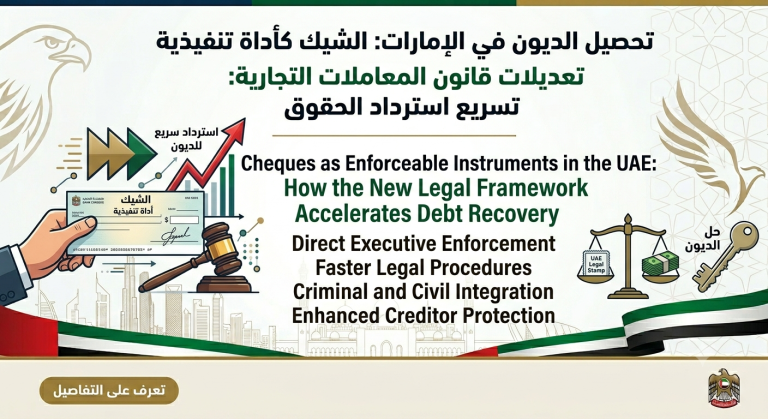
Cheques as Enforceable Instruments in the UAE: How the New Legal Framework Accelerates Debt Recovery
The UAE has introduced significant legal reforms aimed at improving commercial confidence and strengthening debt recovery mechanisms. One of the most impactful changes under Federal Decree-Law No. 50 of 2022 on Commercial Transactions is granting cheques the status of an enforceable instrument in specific circumstances.
This legislative development enables cheque holders to proceed directly to execution before the Execution Court instead of filing a lengthy civil claim or obtaining a payment order. As a result, creditors benefit from faster debt collection, reduced litigation costs, and enhanced legal protection.
Legal Basis for Treating a Cheque as an Enforceable Instrument
The legal foundation for this reform is found in two complementary legislative provisions.
Article 212 of Federal Decree-Law No. 42 of 2022 on Civil Procedures recognizes enforceable instruments, including any document that the law expressly grants enforceable status.
Building upon this principle, Article 667 of Federal Decree-Law No. 50 of 2022 on Commercial Transactions expressly designates a cheque as an enforceable instrument, distinguishing it from other commercial papers such as bills of exchange and promissory notes, which generally require payment order procedures before enforcement.
This approach significantly shortens the legal path to debt recovery while preserving the debtor’s right to challenge execution through the available legal channels.
Conditions for Enforcing a Cheque Directly
A cheque does not automatically become enforceable merely because it has been issued. Several statutory requirements must be satisfied.
Valid Commercial Cheque
The cheque must fulfill all formal and substantive legal requirements prescribed under UAE Commercial Transactions Law. Any defect affecting its legal validity may deprive it of enforceable status.
Timely Presentation
The cheque must be presented for payment within six months from its issuance date.
Failure to present the cheque within this statutory period may result in the loss of its direct enforceability, requiring the creditor to pursue ordinary civil proceedings.
Bank Confirmation
The drawee bank must officially indicate that the cheque has been dishonoured due to:
- Insufficient funds
- No available funds
UAE courts have also consistently recognized account closure as producing the same legal consequence, allowing the cheque holder to seek compulsory execution.
Exclusion of Criminal Circumstances
Direct enforcement does not apply where the cheque involves criminal conduct such as:
- Forgery
- Deliberate alteration preventing payment
- Fraudulent withdrawal of funds before cheque issuance
- Other remaining criminal offences relating to cheques under UAE law
Enforcement Procedure Before the Execution Court
The new framework allows creditors to bypass ordinary litigation and proceed directly before the Execution Judge.
The applicant generally submits:
- The original cheque
- Bank return notice stating the reason for dishonour
- Execution application
- Supporting identification documents
- Required court fees
Once the enforceable formula is granted, the Execution Court may initiate compulsory enforcement measures.
These measures may include:
- Travel ban orders (where legally justified)
- Asset investigation
- Freezing bank accounts
- Attachment of movable and immovable property
- Judicial sale of seized assets
After the debtor is legally notified and the prescribed period expires, the creditor may continue with attachment and sale procedures to recover the outstanding amount.
Creditors may also seek precautionary attachment where the legal requirements under the Civil Procedures Law are satisfied.
Jurisdiction and Execution Disputes
The competent Execution Court is generally the court that issued the enforceable formula, subject to UAE jurisdictional rules.
The Execution Judge has authority to determine both temporary and substantive execution disputes.
Importantly, filing an execution dispute does not automatically suspend enforcement.
Execution normally continues unless the competent court orders otherwise.
Where the dispute concerns the validity of the cheque itself—such as entitlement to payment or maturity—the Execution Judge may require the objecting party to commence substantive proceedings within a specified period while deciding whether execution should continue or be temporarily suspended.
Under UAE law, execution rights may lapse if no enforcement action is taken for fifteen years from the last execution measure or from issuance of the enforceable instrument, as applicable.
Benefits of the UAE Cheque Enforcement Reform
The recognition of cheques as enforceable instruments offers several practical advantages for businesses and creditors.
These include:
- Faster debt recovery
- Reduced litigation time
- Lower legal costs
- Stronger protection of creditor rights
- Increased commercial certainty
- Enhanced confidence in cheque transactions
- Improved efficiency of judicial enforcement
The reform also strengthens the role of cheques as reliable payment instruments within the UAE’s commercial environment.
Conclusion
The UAE’s decision to recognize qualifying cheques as enforceable instruments represents a significant advancement in commercial law and judicial efficiency.
Rather than requiring creditors to commence lengthy civil proceedings, the legislation permits direct access to compulsory execution, provided the statutory conditions are met.
This modern enforcement framework balances the protection of creditor rights with procedural safeguards for debtors, while reinforcing confidence in commercial transactions across the UAE.
Frequently Asked Questions (FAQs)
Can a bounced cheque be enforced without filing a civil lawsuit?
Yes. Under the UAE Commercial Transactions Law, qualifying dishonoured cheques may be enforced directly before the Execution Court without first filing a traditional civil claim.
Does every dishonoured cheque qualify as an enforceable instrument?
No. The cheque must satisfy all statutory conditions, including timely presentation and official confirmation from the bank regarding the reason for dishonour.
Can execution continue if the debtor files an objection?
Generally, yes. Filing an execution dispute does not automatically suspend enforcement unless the competent court orders a stay.
Can the court freeze the debtor's assets?
Yes. The Execution Court may order various enforcement measures, including asset inquiries, attachment of property, bank account freezes, and judicial sale where legally appropriate.
How long does the right to enforce a cheque remain valid?
Under UAE law, execution rights may lapse after fifteen years if no enforcement action is taken during that period.