
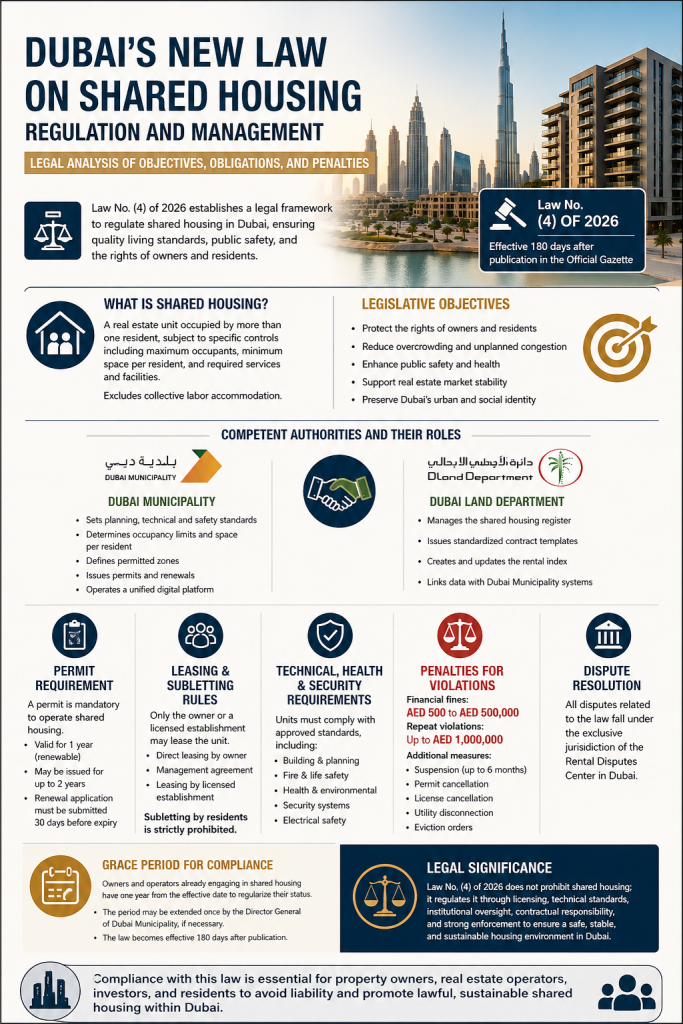
Legal Analysis of Objectives, Obligations, and Penalties
Introduction
In a significant legislative step reflecting the evolving urban and regulatory vision of Dubai, Law No. (4) of 2026 concerning the Regulation of Occupancy and Management of Shared Housing introduces a comprehensive legal framework governing shared housing.
This law addresses key challenges such as overcrowding, misuse of residential properties, and unregulated occupancy, while balancing the rights of property owners, residents, and the broader public interest. It goes beyond traditional landlord-tenant regulation, targeting a unique housing model with direct implications for urban planning, infrastructure, and public safety.
What Is Shared Housing Under Dubai Law?
Under the new framework, shared housing refers to a real estate unit occupied by more than one resident, subject to strict regulatory controls.
These controls include:
- Maximum number of occupants
- Minimum space per resident
- Mandatory facilities and services
The law applies across Dubai, including free zones and special development areas, covering:
- Property owners
- Residents
- Licensed operators
Key Exclusion
- Collective labor accommodations are excluded
Legal Distinction
The law clearly separates:
- Lawful shared housing (regulated and permitted)
- Unlawful practices, such as:
- Overcrowding
- Unauthorized subletting
- Exploitative use of residential units
Legislative Objectives
Dubai’s shared housing law is driven by strong regulatory and social objectives:
- Protect rights of owners and residents
- Improve housing standards
- Reduce overcrowding
- Enhance public safety
- Support real estate market stability
- Preserve urban and social identity
From a legal perspective, the law treats shared housing as more than a private arrangement—it is a matter connected to:
- Urban planning
- Infrastructure capacity
- Public health and safety
- Economic regulation
Competent Authorities
Role of Dubai Municipality
Dubai Municipality is the primary regulator responsible for:
- Setting planning and technical standards
- تحديد عدد السكان والمساحات لكل فرد
- Defining permitted zones
- Issuing permits
- Creating a unified digital licensing platform
Role of Dubai Land Department
The Dubai Land Department oversees:
- Shared housing registry
- Contract templates
- Rental index for shared units
- Linking data with municipality systems
Regulatory Model
This dual structure ensures:
- Technical compliance (Municipality)
- Legal and contractual control (Land Department)
Permit Requirement
The law strictly prohibits operating shared housing without a permit.
Key Conditions:
- Compliance with planning and building standards
- Health and safety requirements
- Defined occupancy limits
- Required services and facilities
Permit Details:
- Valid for 1 year (renewable)
- May extend to 2 years upon request
- Renewal must be submitted 30 days before expiry
Legal Impact
Shared housing is now a licensed activity, not just a contractual arrangement—subject to:
- Prior approval
- Continuous regulatory supervision
Leasing and Subletting Rules
The law clearly limits leasing rights to:
- Property owner
- Licensed establishment
Prohibited:
- Subletting by residents
- Informal rental of internal spaces
Allowed Structures:
- Direct leasing (owner → residents)
- Management agreements
- Licensed re-letting
Practical Impact
This eliminates:
- Hidden occupancy
- Overcrowding risks
- Legal ambiguity
Technical, Health, and Security Requirements
Approval depends on strict compliance with:
- Building and planning standards
- Fire and life safety systems
- Environmental and health requirements
- Security systems
- Electrical safety
This ensures that legal compliance is tied to the physical suitability of the property, not just contractual arrangements.
Penalties for Violations
The law introduces a strict enforcement framework:
Financial Penalties:
- From AED 500 up to AED 500,000
- Up to AED 1,000,000 for repeat violations
Administrative Measures:
- Suspension (up to 6 months)
- Permit cancellation
- Business license cancellation
- Utility disconnection
- Eviction orders via Rental Disputes Center Dubai
Enforcement Model
A graduated system:
- Fines
- Administrative penalties
- Operational shutdown
Dispute Resolution
All disputes fall under the exclusive jurisdiction of:
- Rental Disputes Center Dubai
This ensures:
- Specialized handling
- Faster resolution
- Consistency in rulings
Grace Period for Compliance
The law provides a grace period of one year for:
- Existing property owners
- Current operators
Key Points:
- Starts after the law comes into force
- Can be extended once if necessary
- Law becomes effective 180 days after publication
Practical Meaning
Stakeholders must:
- Regularize permits
- Upgrade properties
- Adjust contracts
Failure to comply after the grace period leads to penalties.
Legal Commentary and Practical Significance
Law No. (4) of 2026 represents a major shift in regulating shared housing in Dubai.
It does not prohibit the concept—but legalizes and structures it through:
- Licensing
- Technical compliance
- Institutional oversight
- Contractual clarity
- Strong enforcement
The law protects:
- Property owners
- Tenants
- Urban infrastructure
- Public safety
- Market stability
Conclusion
Dubai’s shared housing law reflects a modern legislative approach that integrates:
- Real estate regulation
- Urban planning
- Public safety
- Social stability
For:
- Property owners
- Investors
- Real estate operators
- Residents
Compliance is no longer optional—it is essential for operating legally and sustainably within Dubai’s evolving real estate framework.
Failure to comply may result in:
- Heavy fines
- Eviction
- Business closure
- Legal liability