
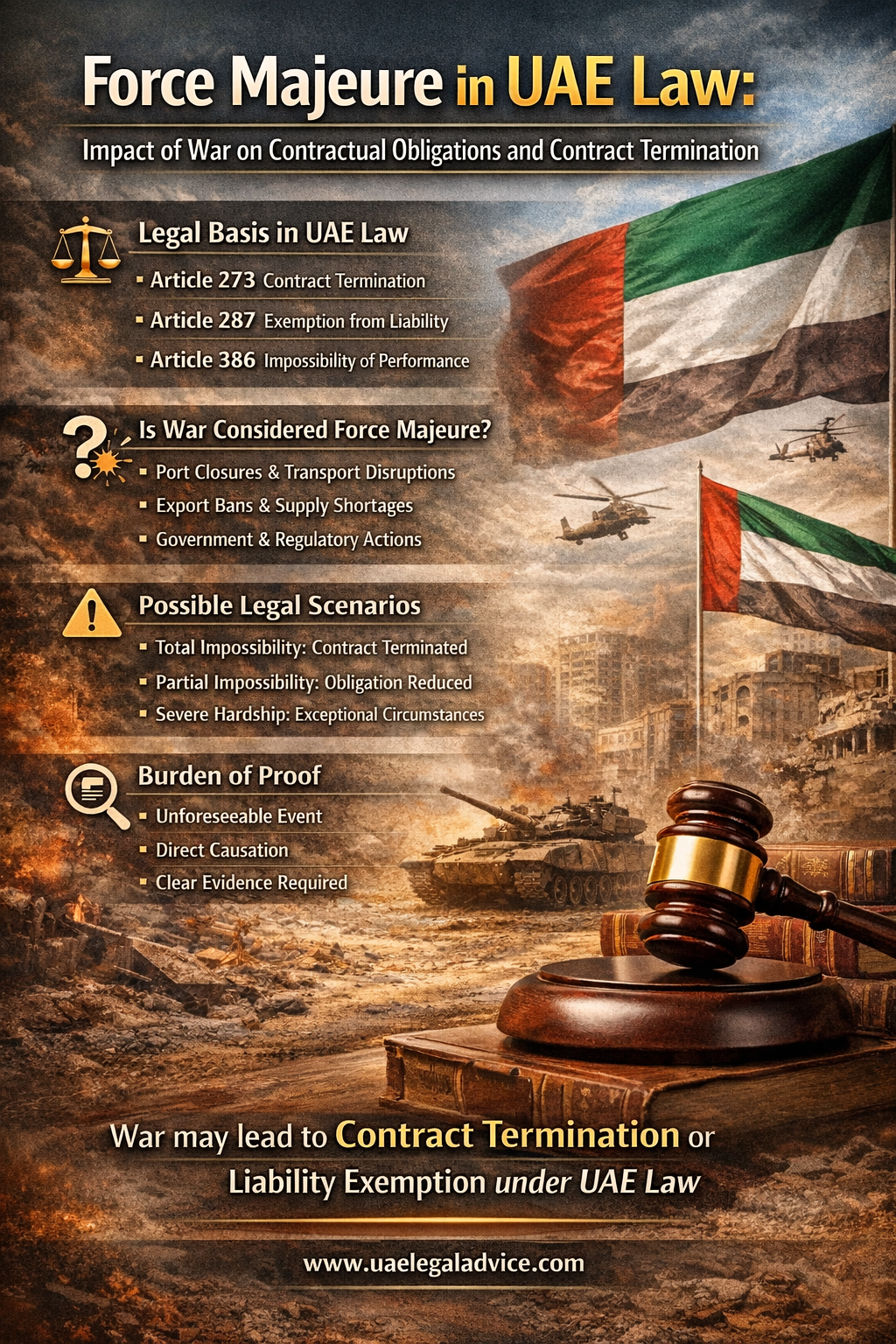
In light of the current regional circumstances and the potential consequences of wars or armed conflicts, including supply chain disruptions, transportation closures, and shortages of essential materials and services, the concept of force majeure in UAE law has become one of the most significant legal issues affecting the performance of contractual obligations.
As a general legal principle, contracts are binding upon the parties and must be executed in accordance with their terms and in good faith. However, this principle is not absolute. Exceptional circumstances or uncontrollable events may arise that render contractual performance impossible or excessively burdensome.
The UAE Civil Transactions Law addresses this balance explicitly through provisions regulating contract performance, exceptional circumstances, force majeure events, and liability for non-performance.
Legal Basis of Force Majeure in UAE Civil Transactions Law
The legal framework governing force majeure in UAE law is primarily derived from several provisions within the UAE Civil Transactions Law, which regulate the consequences of unforeseen events affecting contractual performance.
Article 273 – Effect of Force Majeure on Contracts
Article 273 of the UAE Civil Transactions Law states that if a force majeure event occurs in a bilateral contract and makes the performance of an obligation impossible, the corresponding obligation is extinguished and the contract is automatically terminated.
If the impossibility is partial, only the corresponding portion of the obligation is extinguished. In cases where the impossibility is temporary, particularly in continuous or long-term contracts, the obligation may be suspended for the duration of the impediment. In such cases, the creditor may request termination if the conditions justify it.
This article serves as the central legal provision governing the consequences of force majeure on contractual relationships.
Article 287 – Foreign Cause and Exemption from Liability
Article 287 establishes that a person shall not be liable for damages if it is proven that the harm resulted from an external cause beyond their control. Examples of such causes include natural disasters, sudden accidents, force majeure events, acts of third parties, or the act of the injured party.
Unless otherwise stipulated by law or agreement, such foreign causes may exempt a party from liability for damages resulting from non-performance.
Article 386 – Impossibility of Performance
Article 386 further confirms that if a debtor becomes unable to perform an obligation in kind, compensation may be awarded unless the debtor proves that the impossibility of performance resulted from a foreign cause beyond their control.
Together, these provisions demonstrate that force majeure in UAE law may lead to contract termination, suspension of obligations, or exemption from liability depending on the circumstances of each case.
Is War Considered Force Majeure in UAE Law?
War itself does not automatically invalidate contracts or cancel obligations. However, it may constitute force majeure under UAE law if it results in a genuine impossibility of performance beyond the control of the contracting party.
This legal characterization does not arise merely from the existence of armed conflict in the region. Rather, it must be demonstrated that the war or its direct consequences actually prevented the performance of the contractual obligation.
Examples of situations where war may qualify as force majeure include:
• Government closure of ports or borders
• Export or import restrictions
• Suspension of maritime or air transportation
• Severe disruption of supply chains
• Shortage of essential materials
• Sovereign or regulatory decisions preventing contract execution
When such circumstances directly prevent performance, they may qualify as force majeure under UAE law.
Legal Scenarios Resulting from War
War and its consequences may create several different legal situations affecting contractual obligations.
Total Impossibility
If the war or its consequences make contractual performance completely and permanently impossible, the contract may be automatically terminated in accordance with Article 273 of the UAE Civil Transactions Law.
Partial or Temporary Impossibility
If only part of the contractual obligation becomes impossible, the corresponding portion of the contract is extinguished. In continuous contracts, the obligation may be temporarily suspended during the duration of the impediment.
Severe Hardship Without Impossibility
In certain cases, performance remains technically possible but becomes extremely costly or financially damaging due to war-related disruptions. In such situations, the matter may fall under the doctrine of exceptional circumstances rather than force majeure.
Difference Between Force Majeure and Exceptional Circumstances
The distinction between force majeure and exceptional circumstances is highly important in contracts affected by wars or economic crises.
Article 249 of the UAE Civil Transactions Law provides that if exceptional public events occur which were unforeseeable at the time of contracting and make the performance of an obligation excessively burdensome, threatening the debtor with severe loss, the court may intervene.
In such cases, the judge may reduce the burdensome obligation or modify its terms in order to restore contractual balance between the parties.
The key difference is that under exceptional circumstances the obligation remains possible, while under force majeure performance becomes impossible.
Wars may initially create economic hardship through price increases or supply disruptions, qualifying as exceptional circumstances. However, if the situation escalates to the point where performance becomes impossible, the situation may then qualify as force majeure in UAE law.
Is a Force Majeure Clause Required in Contracts?
Legally, invoking force majeure in UAE law does not require the existence of a specific contractual clause because the Civil Transactions Law itself regulates its consequences.
However, including a force majeure clause in contracts is strongly recommended in practice.
Such clauses typically define:
• Notification requirements
• Documentation needed to prove the event
• Suspension periods for obligations
• Contract extension rights
• Risk allocation between the contracting parties
If the contract does not include such a clause, disputes will be resolved based on general legal principles, evidentiary rules, and the principle of good faith in contract performance.
Impact of War on Contractual Obligations
When a contracting party proves that war or its consequences constituted a foreign cause that made performance impossible, the party may be exempted from liability for damages.
The legal effects depend on the severity of the impact:
If performance becomes completely impossible, the contract may automatically terminate.
If the impossibility is partial, only the corresponding portion of the obligation is extinguished.
If the impossibility is temporary, performance may be suspended for the duration of the impediment.
If performance remains possible but extremely burdensome, the affected party may seek judicial relief to restore contractual balance.
Article 246 of the UAE Civil Transactions Law also requires that contracts be performed in good faith. Therefore, a party invoking war as a force majeure event must demonstrate genuine impossibility and must not rely on the situation as a pretext to evade contractual obligations.
Burden of Proof in Force Majeure Claims
A party invoking force majeure in UAE law must provide sufficient evidence to prove several essential elements.
These include the occurrence of an external event, the impossibility of predicting the event at the time of contracting, the inability to avoid its consequences through reasonable means, and the existence of a direct causal relationship between the event and the failure to perform the obligation.
Evidence in commercial disputes may include:
• Government decisions restricting trade or transport
• Official shipping company notifications
• Supply chain disruption notices
• Certificates confirming transport suspension
• Communications from suppliers
• Official regulatory restrictions
The stronger the link between the war and the contractual disruption, the stronger the legal argument for force majeure.
Legislative Developments and Contractual Balance
Recent legislative developments in the UAE reflect an increasing focus on maintaining contractual balance during extraordinary circumstances.
Modern legal frameworks allow courts greater flexibility in addressing crises such as global conflicts, pandemics, and economic shocks.
Courts may therefore extend deadlines, adjust compensation, rebalance contractual obligations, or terminate contracts where fairness and justice require such intervention.
Conclusion
War may constitute force majeure in UAE law, but not merely because it occurs in the region. It must be proven that the war or its consequences directly caused the impossibility of performing the contractual obligation.
If performance becomes completely impossible, the contract may terminate automatically under Article 273 of the UAE Civil Transactions Law.
If the impossibility is partial or temporary, the legal consequences are limited to the affected portion or duration.
If performance remains possible but becomes excessively burdensome, courts may intervene under Article 249 to restore contractual balance.
Ultimately, exemption from liability depends on proving the existence of a foreign cause under Articles 287 and 386, while the principle of good faith continues to govern the conduct of contracting parties during exceptional circumstances.