
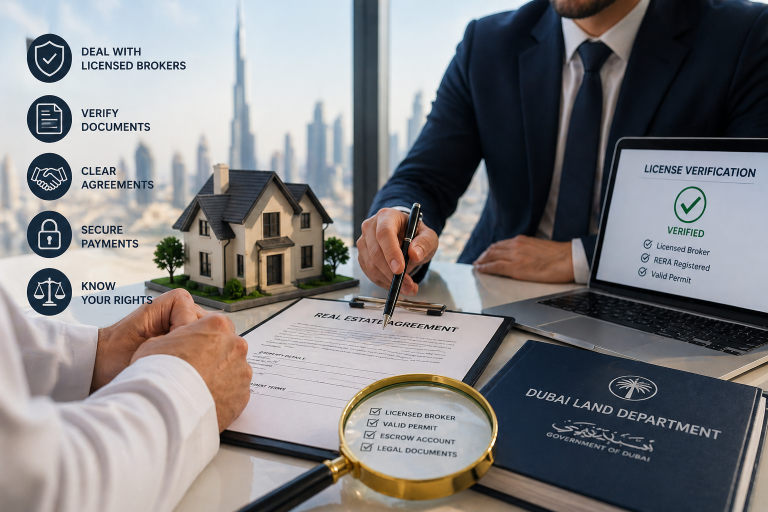
Legal Precautions When Dealing with Real Estate Brokerage Companies in the UAE
Real estate brokerage companies play a major role in the real estate market in the United Arab Emirates. They facilitate property sales, purchases, and leasing transactions while connecting property owners with buyers, landlords with tenants, and developers with investors.
However, dealing with a real estate broker should never rely solely on trust or verbal promises. Every transaction should be supported by proper legal verification, clear documentation, and compliance with UAE real estate regulations.
With the rapid growth of digital real estate marketing and social media advertising, risks relating to fake property listings, misleading advertisements, and unlicensed brokers have significantly increased. Understanding the legal precautions before dealing with any brokerage company can help protect buyers, investors, tenants, and landlords from serious legal and financial disputes.
Why Legal Precautions Matter in UAE Real Estate Transactions
Real estate transactions often involve large financial commitments. Failing to verify a broker’s licence, authority, or advertisement legitimacy may expose clients to:
- Financial fraud
- Invalid transactions
- Fake property listings
- Disputes over deposits or commissions
- Delays in off-plan projects
- Legal complications relating to ownership or payments
For this reason, legal due diligence is essential before signing agreements or making payments.
1. Avoid Dealing with Unlicensed Real Estate Brokers
One of the most important precautions is ensuring that the broker or brokerage company is properly licensed.
In Dubai, real estate brokerage activity is regulated by the Dubai Land Department and the Real Estate Regulatory Agency.
Clients should never rely solely on:
- Social media pages
- Online advertisements
- WhatsApp communications
- Business cards
Instead, verify that:
- The brokerage company holds a valid commercial license
- The broker is properly registered
- The broker holds an active professional card where required
2. Beware of Fake or Misleading Real Estate Advertisements
Misleading real estate advertisements are among the most common risks in the UAE property market.
Examples include:
- Advertising unavailable properties
- Displaying fake prices to attract buyers
- Using inaccurate photos
- Publishing misleading investment returns
In Dubai, many real estate advertisements require official permits issued through systems such as Trakheesi.
Warning Signs of Risky Advertisements
Be cautious if the advertisement:
- Contains vague property details
- Uses unrealistic pricing
- Pressures immediate payment
- Cannot be independently verified
- Lacks clear broker or company information
3. Never Pay Deposits Without Official Documentation
Paying deposits without proper written documentation is one of the biggest legal risks in real estate transactions.
Before making any payment, ensure there is a written document clearly stating:
- Purpose of the payment
- Property details
- Amount paid
- Refund conditions
- Identity and capacity of the recipient
Important Safety Rule
Avoid transferring money to personal bank accounts unless there is a clear legal justification.
This precaution is especially important in off-plan property sales.
4. Verify the Broker’s Legal Authority
A broker may only have limited authority.
For example, the broker may be authorized to:
- Market the property
But may NOT be authorized to:
- Receive deposits
- Amend prices
- Sign agreements
- Make guarantees on behalf of owners or developers
Always verify the broker’s authority in writing before relying on any promises or representations.
5. Do Not Rely on Verbal Promises
Verbal promises frequently lead to real estate disputes.
Examples include promises relating to:
- Guaranteed investment returns
- Rental income guarantees
- Future resale profits
- Delivery dates
- Fee exemptions
Golden Rule
If it is not written in the contract or official documentation, do not rely on it.
All important promises should be documented in writing.
6. Ensure the Broker’s Commission Is Clearly Written
The brokerage commission should always be clearly documented.
The agreement should specify:
- Commission percentage or amount
- Who pays the commission
- Payment timing
- Conditions for entitlement
In Abu Dhabi, broker commission regulations are subject to certain limits regulated by the Abu Dhabi Real Estate Centre.
7. Watch for Conflicts of Interest
Some brokers may have financial relationships with:
- Developers
- Property owners
- Property management companies
This may influence their recommendations.
Ask the broker directly:
- Who do you represent?
- Who pays your commission?
- Do you have any financial interest in this transaction?
Transparency is essential.
8. Exercise Extra Caution in Off-Plan Property Sales
Off-plan property purchases involve additional risks because construction may not yet be completed.
Before purchasing off-plan property, verify:
- Project registration
- Developer licensing
- Escrow account compliance
- Payment procedures
- Cancellation and refund terms
Common Off-Plan Risks
- Construction delays
- Project cancellation
- Specification changes
- Refund disputes
9. Read Reservation Forms and Brokerage Agreements Carefully
Many buyers sign documents without reviewing important clauses.
These documents may contain terms relating to:
- Non-refundable deposits
- Commission obligations
- Administrative fees
- Dispute jurisdiction
- Cancellation penalties
Always read documents carefully before signing.
10. Verify Property Details Before Payment
Before signing or paying, confirm essential property information such as:
- Ownership details
- Unit number
- Property area
- Existing mortgages
- Outstanding fees
- Service charges
- Lease status
In jointly owned properties, additional obligations may apply regarding maintenance fees and building regulations.
11. Understand Anti-Money Laundering Requirements
The UAE real estate sector is subject to anti-money laundering regulations.
Brokerage companies may request:
- Identity documents
- Proof of funds
- Financial information
These requirements are part of regulatory compliance obligations.
Suspicious payment structures or unclear sources of funds may create legal concerns.
12. Understand the Legal Risks and Penalties Affecting Brokers
Violations by brokers may result in:
- Warnings
- Fines
- Suspension
- Blacklisting
- Cancellation of registration
Dealing with non-compliant brokers may expose clients to additional legal risks.
How Can You Protect Yourself Before Dealing with a Real Estate Broker?
Before entering any transaction:
Verify the brokerage license
Check the broker registration details
Verify advertisement permits
Request written proof of authority
Avoid personal account transfers
Document commissions in writing
Read all agreements carefully
Keep copies of receipts and communications
For high-value or off-plan transactions, legal review of documents is strongly recommended.
Conclusion
Dealing with real estate brokerage companies in the UAE can be safe when transactions are conducted through licensed brokers, compliant companies, and properly documented agreements.
However, relying on verbal promises, fake advertisements, undocumented payments, or unlicensed brokers may expose parties to serious financial and legal risks.
The Golden Rule in Real Estate Transactions
Never sign, pay, or rely on promises before verifying:
- The broker’s license
- Legal authority
- Property documents
- Advertisement legitimacy
- Proper payment channels
Frequently Asked Questions (FAQ)
How can I verify whether a real estate broker is licensed in Dubai?
Is it safe to transfer money directly to a broker?
What are the risks of fake real estate advertisements?
Why are off-plan property purchases riskier?
Should brokerage commission agreements always be written?
Yes. Written commission agreements help prevent disputes regarding payment obligations and commission entitlement.