
Civil Marriage Requirements in the UAE for Muslims and Non-Muslims
The United Arab Emirates (UAE) has witnessed significant legislative developments in recent years regarding family law, particularly with the introduction of civil marriage alongside Islamic marriage regulations. This development has raised practical and legal questions about civil marriage requirements, its scope, eligibility, and differences from religious marriage, especially in cases involving different religions or nationalities.
This article provides a comprehensive legal analysis of civil marriage requirements in the UAE, highlighting distinctions between Muslims and non-Muslims, and outlining the three current legal pathways based on existing legislation and official judicial guidance.
What Is Civil Marriage in UAE Law?
Civil marriage is a legally recognized contract documented before a judicial authority or authorized registrar, based purely on civil law principles without religious rituals. It carries legal consequences regarding marriage, divorce, alimony, and child custody, depending on the governing law under which the contract is executed.
In the UAE, civil marriage has two primary pathways:
Federal pathway: Governed by a federal decree applicable to non-Muslims.
Local pathway: Regulated by Abu Dhabi’s local civil marriage law.
Civil Marriage Requirements for Non-Muslims (Federal Pathway)
Scope of Application
The federal civil marriage system applies to:
Non-Muslim UAE citizens.
Non-Muslim expatriates residing in the UAE.
In some cases, parties may choose to apply their home country’s law, subject to legal conditions.
Key Requirements for a Valid Marriage Contract
To be legally valid, a civil marriage must meet the following minimum conditions:
Both parties must be at least 21 years old.
No prohibited degrees of kinship (up to the third degree according to regulations).
Explicit consent from both parties before the registrar, free of defects in consent.
Signing the official disclosure and acknowledgment forms.
Full legal capacity of both parties.
The marriage must be between a male and a female.
No existing marriage, and full disclosure of any prior or current marital relationships.
Procedures and Required Documents
Civil marriage registration involves:
Appearance before a competent registrar or judicial officer.
Submission of identity documents and residency proof.
Proof of age and marital status.
Signing official forms, with the option to include contractual conditions agreed upon by both parties.
Civil Marriage for Muslims – Legal Distinctions
Can Muslims Enter a Federal Civil Marriage?
No. The federal civil marriage pathway is exclusively for non-Muslims. Muslims are not eligible to contract a federal civil marriage.
When Can Muslims Have a Civil Marriage in the UAE?
Practical judicial guidance indicates:
Non-citizen Muslims: May contract civil marriage in Abu Dhabi.
Citizen Muslims: Must follow personal status law (Islamic marriage); civil marriage is not applicable.
Civil Marriage in Abu Dhabi
Abu Dhabi’s civil marriage law is flexible, allowing civil marriages regardless of religion, except for UAE citizens.
Key requirements include:
Minimum age: 18 years old.
Full consent from both parties.
No first- or second-degree kinship.
No existing marital relationship.
At least one party must be a non-citizen.
No witnesses required.
No mandatory premarital medical test.
Contract registration before a judicial registrar and signing the acknowledgment form.
Islamic Marriage (Personal Status Law)
For Muslims, Islamic marriage governed by Personal Status Law has different requirements:
Minimum age: 18 years (with judicial exceptions).
Offer and acceptance (Ijab and Qabul).
Presence of a guardian (Wali) for the Muslim bride, in specified cases.
Two witnesses.
No religious prohibitions or impediments.
Islamic marriage focuses on religiously mandated pillars, unlike civil marriage, which relies solely on consent and registration.
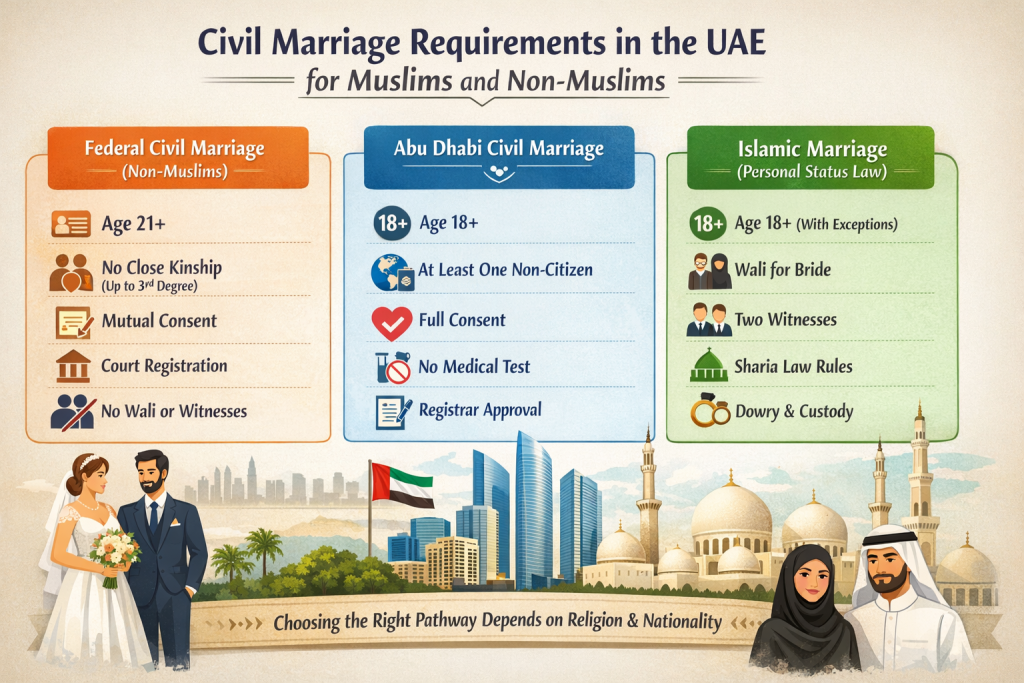
Comparative Overview of Marriage Pathways in UAE
Federal Civil Marriage (Non-Muslims):
Age 21+, full legal capacity, no prohibited kinship.
No Wali or witnesses required.
Contract documented before a court registrar, with optional contractual clauses.
Abu Dhabi Civil Marriage:
Age 18+, full consent, no first- or second-degree kinship.
No Wali or witnesses required; no medical test.
Open to all religions except UAE citizens; practical pathway for non-citizen Muslims.
Islamic Marriage (Personal Status Law):
Age 18+ (judicial exceptions possible).
Requires Wali and two witnesses.
Governed by Sharia law; covers marriage, dowry, alimony, custody, and divorce.
Conclusion
Choosing the appropriate marriage pathway in the UAE depends on religion, nationality, and place of registration. Civil marriage offers flexibility for non-Muslims and some non-citizen Muslims, while Islamic marriage remains the default framework for Muslim citizens.
Due to the legal implications of each pathway, it is advisable to conduct a prior legal assessment to ensure the protection of rights and family stability in accordance with applicable laws.