
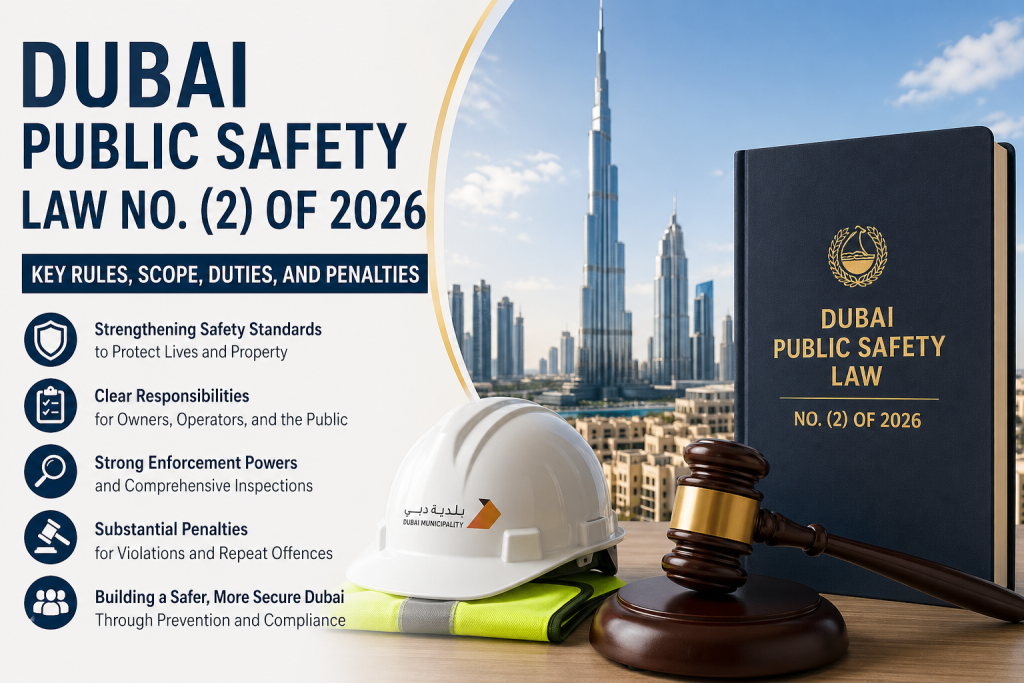
Key Rules, Scope, Duties, and Penalties
Dubai continues to strengthen its regulatory landscape with the introduction of Dubai Public Safety Law No. (2) of 2026, a comprehensive legal framework designed to enhance safety standards across the Emirate. The law reflects a proactive approach to protecting lives, property, and public wellbeing by imposing clear obligations on businesses, property owners, event organizers, and individuals.
It also grants broad supervisory and enforcement powers to authorities, ensuring that compliance is not only required—but actively monitored and enforced.
適用範圍
The law applies to a wide range of public-facing environments within 杜拜, including:
- Public places
- Entertainment venues
- Events and exhibitions
- Commercial and residential buildings
- Free zone establishments
This broad scope ensures unified safety standards across sectors that interact directly with the public.
Excluded Sectors
Despite its wide reach, the law excludes certain sectors that are already governed by specialized regulations, including:
- Airports
- Military facilities
- Ports
- Transportation systems
- Industrial facilities
- Buildings under construction (except publicly accessible areas)
This distinction avoids regulatory overlap while maintaining safety oversight where public interaction exists.
Main Objective of the Law
The primary goal of the law is to protect human life and property through a structured and preventive safety framework.
It focuses on:
- Accident prevention
- Risk mitigation
- Safe products and services
- Public awareness and education
- Standardization of safety measures
Importantly, the law goes beyond reactive enforcement. It emphasizes prevention before incidents occur, promoting a culture of safety across all sectors.
Competent Authority and Its Powers
The law designates the Environment, Health and Safety Institution of Dubai Municipality as the competent authority under Dubai Municipality.
Key Powers Include:
- Setting and enforcing safety standards
- Issuing permits and approvals
- Conducting inspections
- Investigating incidents
- Monitoring equipment and products
- Developing implementing regulations
- Raising public awareness
- Creating safety databases
This wide authority ensures both regulatory oversight and proactive governance, enabling swift responses to risks and violations.
Core Safety Requirements
The law mandates essential safety measures across all covered premises and activities, including:
- Approved safety-compliant equipment
- Fire protection and evacuation systems
- First aid readiness
- Emergency response plans
- Crowd control and capacity management
- Safety signage and warnings
Protection of Vulnerable Groups
A notable feature of the law is its inclusive approach. It requires consideration of:
- People with disabilities
- Elderly individuals
- Children
This ensures safety compliance is comprehensive and socially responsible.
Responsibilities of Owners and Operators
Property owners and operators bear the primary responsibility for ensuring compliance.
Their obligations include:
- Adhering to all safety standards and regulations
- Obtaining necessary permits and approvals
- Conducting risk assessments
- Performing regular maintenance
- Reporting incidents immediately
- Restricting access during hazardous activities
- Appointing safety supervisors when required
These duties highlight that compliance is an ongoing operational responsibility, not a one-time requirement.
Obligations of the Public
Public safety is not limited to authorities and businesses—the law also places responsibility on individuals.
Members of the public must:
- Follow safety instructions
- Cooperate during emergencies
- Avoid restricted or hazardous areas
- Properly supervise children
This reflects a shared responsibility model, where everyone contributes to maintaining safety.
Prohibited Acts
The law clearly defines activities that are strictly prohibited, including:
- Selling or distributing unsafe products
- Conducting hazardous activities without authorization
- Engaging in behavior that endangers public safety
These provisions provide a strong legal basis for enforcement against unsafe practices.
Inspection Powers and Penalties
Authorities are granted extensive inspection and enforcement powers, including the use of modern technologies for monitoring compliance.
Financial Penalties
Violations may result in fines ranging from:
- AED 500 up to AED 1,000,000
- Up to AED 2,000,000 for repeat offences
Additional Enforcement Measures
Beyond fines, authorities may impose:
- Closure of establishments
- Confiscation of unsafe materials
- Destruction of hazardous products
- Withdrawal of non-compliant goods
These penalties underscore the seriousness of non-compliance and its potential operational impact.
Legal Significance
Dubai Public Safety Law No. (2) of 2026 represents a major advancement in the Emirate’s regulatory framework. It introduces a structured system of prevention, compliance, monitoring, and enforcement aligned with international best practices.
For businesses, event organizers, and property stakeholders, this law is not optional reading—it is a critical compliance requirement.
Failure to comply may result in:
- Significant financial penalties
- Business disruption
- Reputational damage
Final Thoughts
This law signals Dubai’s continued commitment to creating a safe, resilient, and globally competitive environment. Organizations operating in the Emirate should proactively review their safety systems, policies, and procedures to ensure full compliance.
Adopting a preventive, well-documented, and standards-driven approach to safety is no longer just best practice—it is a legal obligation.